Even though awareness about Autism has dominated the world of therapies and medical research for the longest time, graphic designers over the globe have started challenging the notion that only therapy and treatment can be the solution for the Autism community.
Graphic designers know they can leverage the power of visual design to normalize life for Autistic individuals and create environments and products that allow ASD individuals to be comfortable in their own skin.
Here are 20+ resources every graphic designer should know to walk in the shoes of their Autistic users and understand the world through their eyes to design for better comprehension:
First things first, before delving into the world of designing for Autistic, it is prudent for graphic designers to glean an in-depth knowledge about the Autism Spectrum, to help them walk in the shoes of their users. This PDF offers a comprehensive know-how of the spectrum.
Before this study, hardly any research has ever investigated color preference in children with Autism Spectrum Disorder (ASD). Autistic individuals experience colors differently than typically developing children due to their enhanced sensitivity to sensory stimulation, as suggested by anecdotal evidence from teachers, caretakers, parents of persons with ASD, and individuals with ASD themselves. Reading up on this study would help graphic designers take color preferences into consideration when designing for Autism.
Designers can actually create meaning for Autistic individuals by leveraging the right colors. This Book explains how colour coding can assist with diversifying diet, enhancing communication, understanding emotions, coping with change, and alleviating anxiety by helping children with Autism create clear visual categories and generalize lessons already learnt. This book would greatly help graphic designers color-code meaning in their designs.
Due to their daily struggles in life, all Autistic people can benefit from access to appropriate services, such as accessible web-based services. This article would help web designers and developers who aspire to ensure that their site is suitable for Autistic people and resonates with them on a deep level of comprehension.
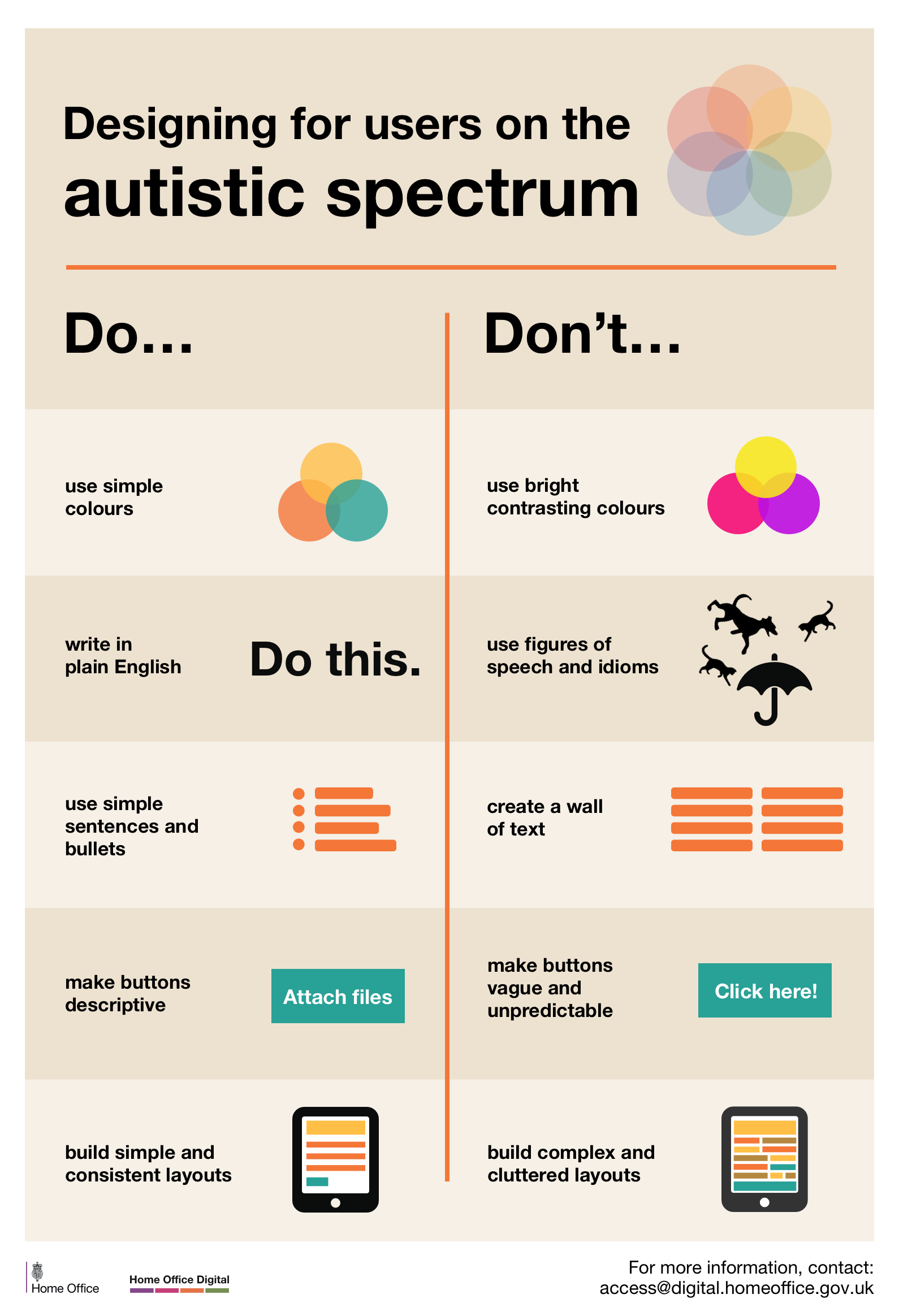
The aim of this awe-inspiring poster is to raise awareness of Autism Spectrum through good design practice. The poster teaches designers that they need to be wary of not just building or designing for their own immediate needs. These general guidelines outline the best design practices for making services accessible in government.
Due to a greater need for predictability, Individuals with Autism Spectrum Disorders (ASD) might experience greater difficulty in changes of routine, shifting attention from one task to another, or confusion when a pattern of behavior is disrupted.
Thus graphic designers must be drilled in basic transition techniques to ease Autistic users into the next activity without agitating them, and design solutions that support the individual during the transition. This article teaches the basic transition methods.
Visual supports help bring in sequence, routine, and structure that most Autistic children need in order to carry on their daily activities. Visual cues can help Autistic users comprehend what is expected of them.
This research paper would help Graphic designers incorporate visual cues in their designs to facilitate successful transitions between each activity and help overcome the communication barrier.
The use of touchscreen-assistive technology as an interdisciplinary research field and intervention for children with Autism, is blooming by the day. However, designing a touchscreen-assistive application for Autistic children is a challenging process.
Through the example of TaLNA apps, this research paper would help graphic designers comprehend the User Interface Design process of forming applications for Autistic individuals.
This research paper takes you through the journey of exploration of a designer into the development of a mobile application for children with Autism Spectrum Disorders (ASD).
This research led to the creation of a tool to generate more mobile application educational opportunities for children with ASD and encourage collaboration between designers and educators to facilitate better learning design.
The biggest challenge faced by graphic designers designing for Autism is that the minds of Autistic individuals process sensory information differently than ours. This is exactly why most universal UI/UX principles fail on this spectrum of users. This valuable article would help graphic designers keep the attention and focus of Autistic individuals in mind when designing for ASD.
Steve Silberman’s latest book, titled “NeuroTribes: The legacy of autism and how to think smarter about people who think differently”, incorporates some potent implications about what “normal” really means and designing for human cognition. In this interview, Steve Silberman talks about how Autism can have an influence on modern design.
Cognition and web accessibility is a highly important field, yet one that is the least understood by designers. In this interview, the amazing up-and-coming Autistic web designer Jamie Knight talks about what the web means to him and what truly accessible web design constitutes, through his personal experiences.
After thorough discussion with Autistic individuals to glean their opinion on how web designers could better meet their needs, the author has developed a rounder picture of the nature of the problems pertaining to User Interface that a person with Autism may face.
Graphic designers should read up on this article to learn about the problems faced by Autistic Individuals when using the web and how they could be resolved through accessible design.
The Autism Spectrum Disorder and Visual Supports program offers an easy-to-understand, step-by-step introduction to visual supports and the ways visual cues can be incorporated in day-to-day life to enhance comprehension for people with Autism.
Designers can read up on these resources to become acquainted with the types of visuals that can assist Autistic Individuals in learning.
Researchers and software designers have constantly looked to technology for finding solutions to help and educate people with Autism, yet very little is known about how these design solutions are actually going to be integrated into the lives of these individuals and their families, which is what this research paper addresses.
Technology has altered the lives of many people with Autism Spectrum Disorders. This research paper enlists the requirements and methodologies needed by designers for developing an accessible user interface for users with Autism Spectrum Disorders (ASD), through the example of the UI of Open Book, an awe-inspiring reading assistive tool for people with Autism Spectrum Disorder.
This pilot study aims to assist designers in developing a pertinent multimedia-supported learning program for students who have Autism Spectrum Disorder. The results of the study are meant to help the multimedia-learning program designers focus on the need of the development of multiple levels of content presentation, development of a clear and simple layout, and use of simple but direct instructions.
Eye tracking studies in young Autistic children have proven a visual attention preference for geometric patterns when viewing dynamic geometric images (DGIs) and paired dynamic social images (DSIs). This study was conducted to examine the impact of stimulus types and age on visual social attention in children with ASD. This study would help graphic designers capture the fleeting attention of children with ASD.
When it comes to comprehending the inner workings of an Autistic mind, what better way for graphic designers to learn than to glean knowledge from their fellow Autistic artists! New York-based behavior analyst Jill Mullin compiled contributions from more than 50 children and international graphic artists who fall somewhere on the Autism spectrum, which designers should peruse to learn the preferences and intricacies of an Autistic person.
Graphic designers around the world are creating environments and products that play to the strengths of Autistic individuals and allow them to be comfortable.
This project came into being to bring together designers who are designing for Autism, so that they can share their knowledge and experiences with other designers. The series hopes to tackle an important question; can Autism-friendly design stand on its own as a discipline?
Children with Autism Spectrum Disorder benefit greatly from visual supports while communicating and learning. These children can learn easily what a certain symbol means and form a connection with an experience, as opposed to learning about it through speech. Designers can use this information to design UI for autistic children in a way that helps them connect with the world with ease.
People share information, messages, stories, or facts through different channels. Some may communicate through speech…
Digital art is a medium that uses computer technology. Instead of using traditional mediums such…
Most kids grow up with a coloring book in their hand, and for good reason.…
Think before you execute. Here's a guide to creating effective logos…without breaking the bank. A…
A website is one of the quickest, most effective ways to introduce yourself and your…
Graphic design is the fusion of art and technology to communicate a message through visual…