Since the beginning of time, each individual born on this planet has undergone an assessment of comparability criteria. This assessment leads to their hierarchical categorization in the human pyramid, where several compartments outline the patterns of the social construct.
As awareness started sprouting a few decades ago, people have been pushing past social boundaries to get included in the streamlined division that regards all people as human beings. Inclusion, as in the name, has become the talk of the town. Take LGBTQ people, women, minorities, and especially the disabled community; each is striving to get accepted by society. And they have been making their place.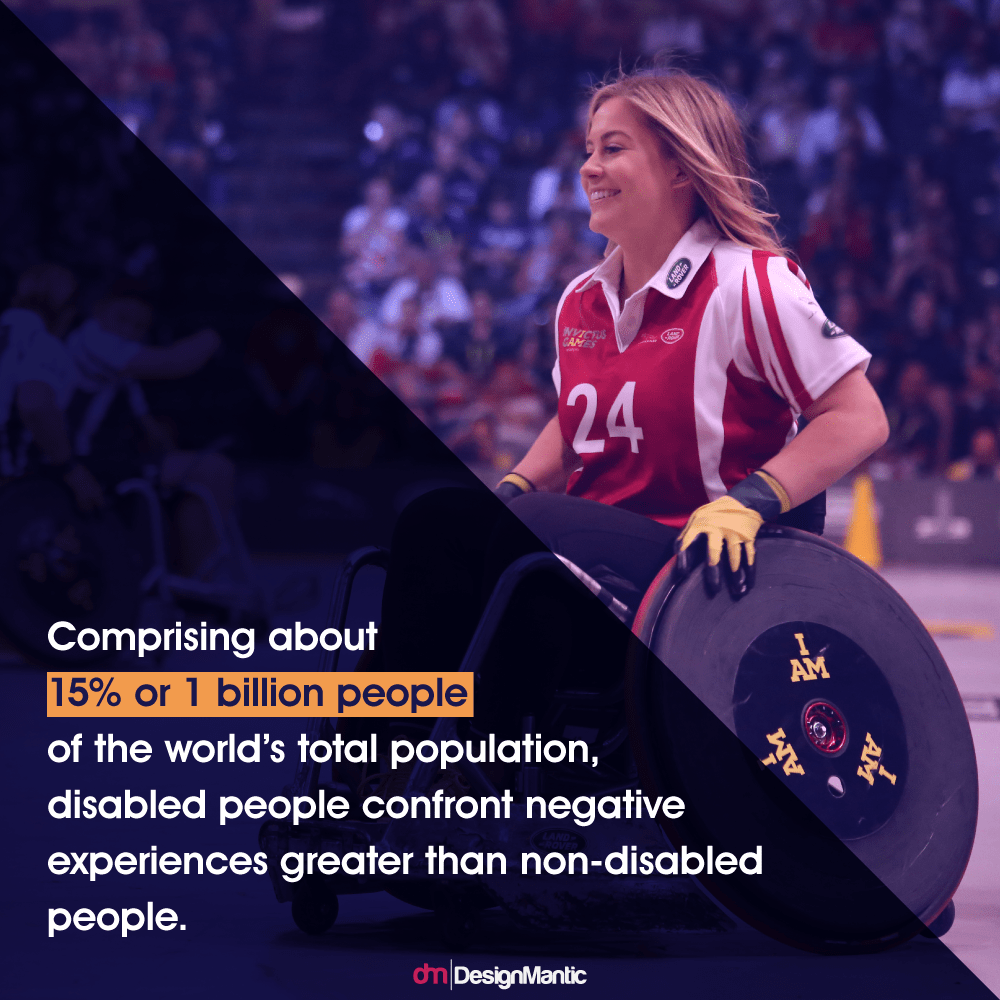
Their inability to fit the ‘ideal’ body norms leaves them behind in the race of life. However, efforts have been made to address the needs of disabled people in every field, especially the graphic design industry.
Neglected Needs of the Disabled in Design
According to the research article, responding to the design needs of disabled people, Rob Imrie pointed out the unanswered need for design structures for disabled people residing in the urban community.
According to Imrie, the design of public buildings and transportation excludes the physical and spatial needs of disabled people. This, however, represents neglect on the part of the individuals responsible for the production of environmental designs.
It isn’t only the concrete jungles that fail to respond to the needs of the disabled; it’s the unavailability of accessible graphic design.
As many people fall victim to disabilities day after day, Cornish and colleagues revealed that visual accessibility lacks proper consideration when it comes to graphic design.
Their study included a survey of 122 graphic designers and their clients, which disclosed a lack of communication and the buildup of misunderstanding, creating barriers in visual accessibility. This, in turn, negatively impacts the inclusion criteria set out for designers.
In congruence with this article, Timothy Cox published a thesis where he discussed the neglected needs of the disabled community. Though the Americans with Disabilities Act (ADA) – formed in 1990 – was a voice against ableism in various parts of life, 10% of the disabled population did not see themselves represented in the graphic design industry.
As reported by Cox, ongoing research by the DisABILITY organization showed that disabled people were not being made part of the design due to a lack of consideration by marketing companies.
These factors, however, bring out the visual disparity which lies between the designers and disabled people and hence, design for disability or designing for an autistic audience remains an unanswered call.
Accessibility and Universal Design: What Do They Mean
As the term accessibility has been mentioned before, one must wonder what it actually means. In the context of design, accessibility responds to the users’ needs to use and interact with a design. It should be accessible to all, irrespective of the individual’s personal, cultural, physical, and socioeconomic status.
In the web context, disabled people can understand, perceive, control, and interact with web elements. It tends to improve usability and inclusiveness altogether.
Accessibility overlaps with the concept of Universal Design. Ronald Mace, the creator of the term ‘Universal Design’, was a handicapped architect who advocated accessibility in every aspect of design.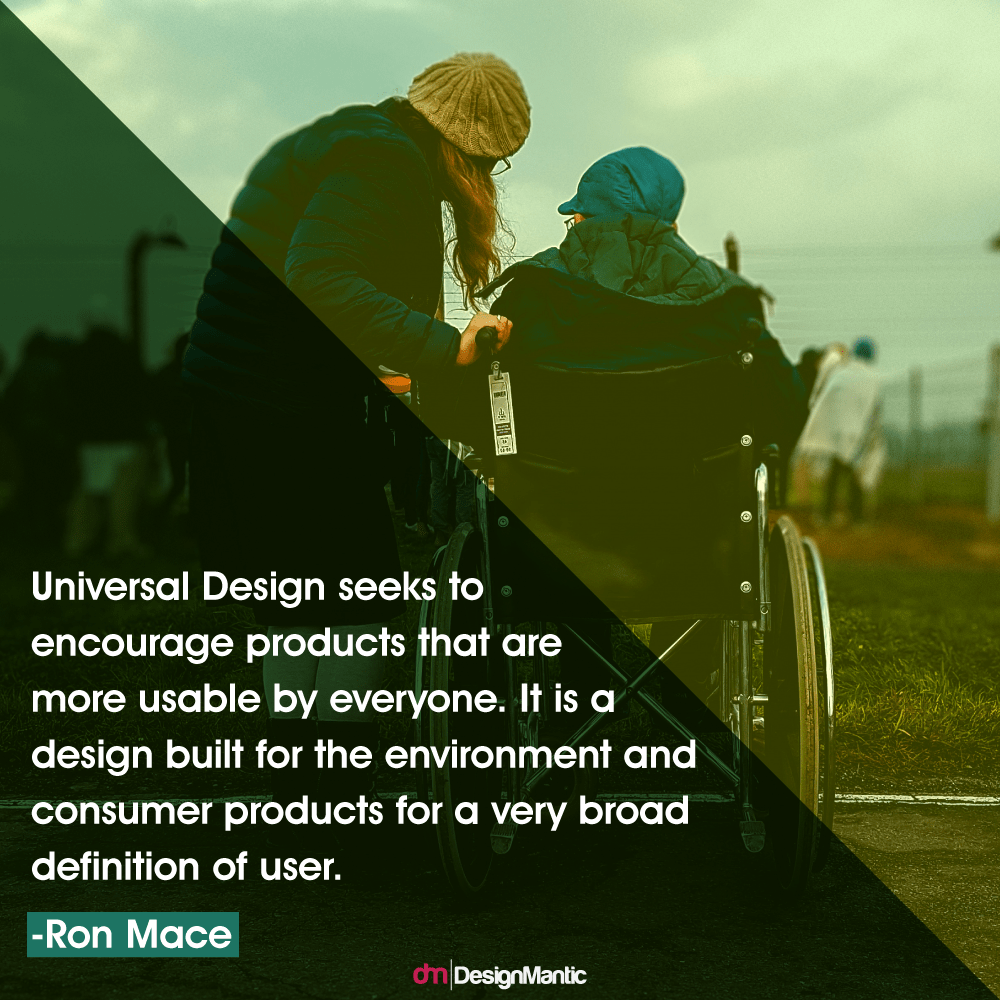
Universal design (aka the design for all or the inclusive design) is a comprehensive term that addresses the needs of every individual when it comes to accessibility. Universal access allows non-impaired as well as impaired individuals to respond to the design equally. Accessibility deals with the concept of usability, while universal design is more of a user-oriented term. However, it is more important to consider the design requirements of disabled people.
Areas of Disability to Consider
The design must be inclusive, accessible, informative, and flexible for every user. However, the designers must consider the following areas of disabilities when designing for accessibility:
Visual: The most common forms of disability that hinder accessibility arise due to problems in visual communication. Any sort of visual impairment, such as reduced or limited eyesight, color blindness, and blindness, must be considered while designing.
Mobility: The use of arms and legs can be an issue for the handicapped and the physically impaired. They might have problems accessing the web and even some keyboard and mouse features.
Auditory: The distortion of auditory abilities in an individual can vary to certain degrees and range up to total deafness.
Cognitive: The term cognitive doesn’t portray the below-average users, but points out the issues when it comes to accessing the design, whether print or online. Problems associated with visualizing the design at hand and short-term memory issues position the disabled in this category. The disabled can also suffer from neurocognitive disabilities, including seizures, dyslexia, and sensitivity to light etc.
Developing Accessibility Guidelines and Codes for All
Since a design is only useful when it’s easily accessible, design accessibility is often associated with disabled people. You may take an example of a healthy construction worker, who became handicapped in a worksite accident.
For a moment, one can fall from an ‘able-bodied’ status to a ‘disabled’ status. Mobility becomes an impossible task and one is plunged into the darkness and never walks again. That is why designers need to follow certain codes and guidelines of accessibility for all, especially when it comes to designing for disabled people.
• Americans with Disabilities Act (ADA)
The United States Department of Labor (DOL) describes the Americans with Disabilities Act (ADA) as the law catered solely for the disabled population. It covers every aspect of their lives i.e. legal rights, transportation, job accommodation, employee rights, self-employment, and so on. The DOL assists the disabled via publications and other technical roles, thereby integrating legal requirements.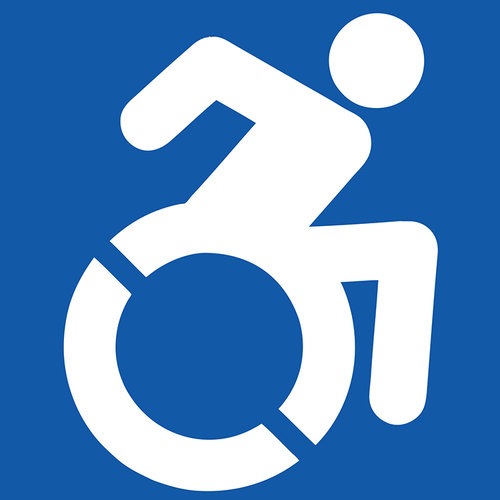
• Accessible Icon Project
Apart from the governmental initiatives to include the disabled as part of the overall community, design activism is also on the rise. When you walk past a street sign, you must’ve seen a specific symbol representing the disabled: a man in a wheelchair. This graphic icon belongs to the Accessible Icon Project, as shown in the figure below.
The Accessible Icon Project offers its services for people with disabilities and collaborates with them to make the world an accessible place for all. The icon started thriving as a street art campaign that included stickers and graffiti. But this project needed a more professional touch and collaboration with disability advocates from across the US.
As the foundation of a building is laid by a single brick, the Accessibility Icon Project soon gained recognition after several years of continuous efforts and partnered with a pro graphic designer, Tim Ferguson Sauder, to give the usual icon a professional touch. Moreover, partnering with a popular organization, Triangle, Inc., the Accessibility Icon Project has gained recognition worldwide and its graphic icon has earned a respectable status after all.
• World Wide Web Consortium (W3C)
The World Wide Web Consortium (W3C) is also a disability-focused international community that focuses on web accessibility for all. It operates under a specific set of Codes of Ethics, which allows the promotion of professional practice with the highest standards. Furthermore, its collaboration and partnership with FIDO has achieved a grand milestone in bringing simple yet authenticated web use to users worldwide.
W3C’s statement of Intent goes as:
“W3C is committed to maintaining a positive work environment. This commitment calls for a workplace where participants at all levels behave according to the rules of the following code. A foundational concept of this code is that we all share responsibility for our work environment.”
Designers, Disabled, and the Lens of Accessibility & Design
In the field of graphic design, designers are often faced with several issues related to accessibility. How can they create a design that meets the needs of every user? How can they make sure their design is perceived positively by all? These questions and similar ones can be answered if only designers look for the ‘invisibles’ aka the disabled community, through the lens of accessibility and graphic design.
Looking through the eyepiece of accessible design might help designers understand the basic needs for inclusive designs as well as the process of design itself. Not only does the design become accessible, but it also delivers a better experience to users of every kind, including the disabled. Every designer must consider the lens of:
- Audio
- Color
- Controls
- Animation and effects
- Video
- Keyboard layout
- Structure
- Flexibility
- Readability
- Layout
- Icons and Images
What else should a designer know about accessibility? In case you didn’t know, if a design is inaccessible, it becomes more of a trouble than an aid for users, especially disabled ones. There are a few things to remember when one is designing, keeping in view the ‘invisibles’.
1. Innovation Speaks for Accessibility: When designing for accessibility, keep in mind the contrast guidelines and barriers that will come your way in the quest for innovation. You may produce as many designs as you like, but each of your attempts will give you an opportunity to come up with a new perspective. This way, the barriers you confront are actually your way to a more accessible design. Encapsulating every kind of user, beyond any discrimination, can be an impossible task, but they offer the best of challenges.
2. Colors Aren’t the Only Means of Visual Communication: This point comes as a savior for people who are suffering from visual deformities or visual constraints. A designer must make sure that he uses colors to highlight the information that is already visible. Even if you’re using colors, make sure you use any other means to elaborate on why that field was highlighted. You can also make use of broad borders, text (bold/italic), underlines, and so many other tool choices than using color alone.
Related: 10 Commandments of Color Theory
3. Understand Text and Background Contrast: When creating designs for accessibility, a designer must keep in mind the guidelines developed by the W3C. For larger text and images with larger text, the contrast ratio should be 3:1. You can also find some tools for color palettes, via which you can test colors for accessibility. Designers can also use high contrast to enhance visibility.
4. Labels and Borders are More Than Important: As the fad to keep everything less, simpler, and minimalistic is escalating these days, designers are forgetting the main attributes of forms, including border lines and visible labels. For instance, without a boundary, a person with defective vision can possibly miss the text box. Moreover, individuals with cognitive and mobility problems can face issues related to the undefined boundaries and lack of clear labels.
Invisibles Shall No Longer Be Invisible
As time goes by, responding to the needs of disabled people is becoming a priority. We must all move at the same pace if we need to progress forward. The illusory hyperbole of disability and accessibility needs to shatter and a new, broad vision needs to arise that allows creativity to flourish across all mediums and platforms.
Designs must be universal and must respond to the scattered needs of the disabled. Designers, artists with cognitive disabilities, and disabled people are all human. Both can contribute to making the world a better place for themselves and others. Thus, design and disability must go hand in hand.
Here’s a chunk of inspiration from the world of design, disability, and accessibility. Your enthusiasm and willingness are all that counts to make the invisible visible again.