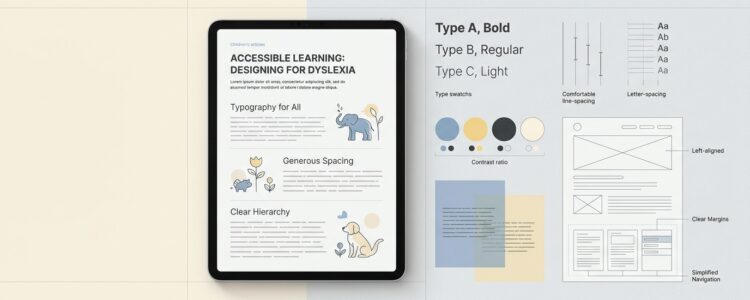
Dyslexia is categorized as a cognitive learning disability, marked by an inability of the brain to translate words into sounds, or phonological processing. This is why Dyslexic children face difficulty in reading and comprehending text.
As a result of their cognitive problems in decoding written language, most Dyslexic individuals confuse similar words, or may even complain of words prancing and swimming across the pages in a chaotic disarray.
Although a large percentage of the population is affected by Dyslexia, approximately 15% to 20%, it manifests itself in so many ways that the problems faced by one Dyslexic may be different from those faced by another.
As such, designers who are faced with the challenging task of creating logo designs, learning material, and brand collateral for a dyslexic audience should be drilled in the preferences of these individuals to cater to their specific needs.
Here are 20 guides that all designers should read to design Dyslexia-friendly resources for Dyslexic children:
1. Typefaces for Dyslexia
After testing for accuracy, reading speed, and comprehension with myriad typefaces, Researchers have revealed the best typefaces for dyslexia that designers should use when designing learning resources for Dyslexic children.
2. Best Typefaces to be used for Dyslexic Individuals
Dyslexia is a learning disability which makes a person very sensitive to particular typefaces, both on screen and in print. This article explores some typefaces which are recommended to designers when creating learning resources for Dyslexic students, so that their material is accessible to as wide-ranging an audience as possible.
Research on Dyslexic individuals reveals that the readability of a piece of text greatly varies according to the typeface or style employed. Read on to discover fonts that are used and recommended by Dyslexic individuals themselves.
3. Best Fonts for Dyslexia
More than 15% of our population is a victim of Dyslexia, a neurological disability that greatly diminishes a person’s ability to write and read. However, mounting evidence shows that the presentation of text has a great bearing on the accessibility of information for Dyslexic children.
This research paper titled “Good Fonts for Dyslexia” undertakes ground-breaking research using eye-tracking to measure the effect of font type and style on the reading speeds of Dyslexic children. Using the results of their study, the paper lists the most viable fonts to help combat reading impairments.
4. The Effect of Font Size and Line Spacing on Online Readability
One of the most effective and simple ways of improving ease of access to information and usability for people with Dyslexia, is to enhance readability of text in the Web. Readability here denotes the ease with which a person can comprehend and read a body of text.
This study only references the presentation of text and not the actual content. In this context, one of the most crucial factors for readability is line spacing along with font size. This research paper on The Effect of Font Size and Line Spacing on Online Readability is meant to aid designers seeking out the most optimal line and font size for their web pages directed at Dyslexic children.
5. Dyslexia-Friendly Text Formatting
While designers are always on the lookout for the most viable fonts to use when designing for a Dyslexic audience, research shows that in addition to font styles, you can also make your text dyslexia-friendly with two simple adjustments that are hassle-free and don’t require you to install anything on your computer.
Based on the most cutting-edge research, this article on best practices for text formatting enlists two important things designers can do to make their designs more Dyslexia friendly. Read on to know the top Do’s and Don’ts and the general principles.
6. Do’s and Don’ts on Designing for Accessibility
The Do’s and Don’ts of designing for accessibility are a series of posters incorporating the best design practices and general guidelines for making services accessible in government. There are 6 different posters in the series, each catering to an audience from a certain area. One of the posters focuses on enhancing accessibility for Dyslexic children.
7. Influence of Graphic Design of the Text on Reading Quality of Pupils with Dyslexia
The main goal of this research paper is to compare the reading qualities of Dyslexic pupils, in terms of error rates and speed pertaining to both quantity and quality, in relation to varying the graphic design of the text.
The study of graphic modifications as a way of boosting the reading speed of Dyslexic pupils and alleviating the error rate is vital since the primary biological cause of Dyslexia is a dysfunction of the magnocellular system, which reveals itself through impaired visual perception.
8. Top Tips for Creating Dyslexia Friendly Print Materials
The Dyslexia Association has come up with a set of stellar tips for making your print materials easier to comprehend for Dyslexic children.
9. Dyslexia Style Guide
The aim of this PDF Dyslexia Style Guide is to ensure that all your written material factors in to the equation the visual stress experienced by some Dyslexic pupils, and makes learning fun and easy for them.
Adopting best practices aimed for Dyslexic readers not only facilitates learning for them, but also makes your documents easier on the eyes for all readers. It is crucial that all your publications and documents are created to be accessible in alternative formats for students suffering from reading difficulties or visual impairments, such as availability in electronic format which can be accessed through a screen reading software.
Website design should also ideally consider all these factors, and website content should be checked for accessibility by carrying out the simple checks included in this resource.
10. Designing for Dyslexics
This is a series of 3 Articles, wherein the first part discusses the issues of Dyslexia and how web design can have a bearing on the ability of the afflicted students to access the information provided on web pages.
Whereas, the second post discusses color contrast for Dyslexics in relation to readability which helps in comprehension. The third delves into the principles of designing Dyslexia-friendly webpages for dyslexic children.
11. Designing Learning Materials for Dyslexic Students
This resource guideline teaches designers how to design online and face-to-face teaching materials for Dyslexic students.
12. Designing Dyslexia Friendly Documents
This informative post teaches designers the things to consider and the things to avoid when it comes to designing Dyslexia friendly documents, including the right use of colors, images, icons, flow charts, and other graphic-intensive elements.
13. Visual Reading Problems and Colored Filters
In this article on visual reading problems, the DRT research into auditory and visual impairments in poor readers aims to conjure up treatments that will help Dyslexic students become better readers through properly controlled trials. Simple treatments such as viewing text through yellow or blue colored filters can help these children a great deal in reading and comprehending text.
14. Search, Read and Write: An Inquiry into Web Accessibility for People with Dyslexia
The goal of this research paper titled Search, Read and Write is to come up with a viable solution for making the Web accessible for people of diverse cultures, backgrounds, ages, genders, and cognitive, sensory, and physical abilities. This paper discusses WCAG in detail in the context of Dyslexia for search user interfaces specifically and Web in general.
15. Optimal Colors to Improve Readability for People with Dyslexia
This research paper discusses the role of colors in readability in relation to Dyslexia, a learning disability affecting 10-17.5% of English speakers. This study seeks to analyze how a specific aspect of text customization, such as the background and text colors, can serve to boost readability in people with Dyslexia.
16. Designing good books for Dyslexic readers
Imagine having to read a book aloud at school, all eyes fixated on you. Except that the words on the pages appear to be prancing and swimming in front of your eyes, and you feel helpless to do anything. However, one publisher is designing books in a font called Dyslexie, which is expected to make a difference for many.
Listen to his audio lecture about designing good books on his works.
17. Accessible Text: Guidelines for Good Practice
This booklet on accessible text guidelines serves as a guide for designers on ‘how to’ create and design accessible learning resources for Dyslexic students. The author believes that the availability of accessible resources would play an indispensable role in the acquisition of literacy skills by Dyslexic children.
18. Interface Design for Dyslexia: Teachers’ Perception on Text Presentation
The use of online learning materials and educational courseware has the capacity to help Dyslexic children in self-development and education. As the main problem for dyslexic children is reading, it is essential to prepare a guideline for making text presentable in digital presentations.
This research paper on interface design for dyslexia teachers conducted a study to explore teachers’ perceptions on how to get the text right when designing online learning resources for Dyslexic children.
19. A Guide to Dyslexia Friendly Power point
This guide to dyslexia lists all the essentials that designers must follow when designing presentations for Dyslexic students.
20. Web Accessibility and People with Dyslexia: A Survey on Techniques and Guidelines
In order to eradicate learning and accessibility barriers, it is indispensable to design websites with the needs of dyslexic children in mind.
The aim of the study, Web Accessibility and People with Dyslexia, is to analyze the state-of-the-art strategies and methodologies for accessibility for students with dyslexia, aiming to eliminate barriers that these students may face during their interaction with the Web.